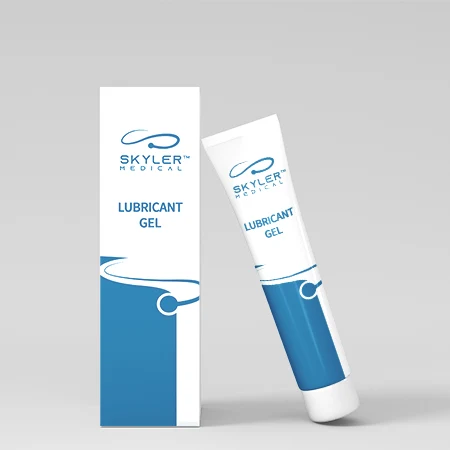
Sterile and non-sterile medical lubricant gel explained for procurement teams: what each grade is for, how quality is controlled, and what to check before ordering.
Written & researched by Poh Tze Kheng, Founder, ORIZI Group · Technical input by Skyler Medical Production Team · Fact-checked by ORIZI Group Editorial · Published by Skyler Medical (an ORIZI Group company) · Last reviewed September 2026
Disclosure: This article is published by Skyler Medical, an ORIZI Group company, and may refer to our own manufacturing experience and capabilities. External factual claims are supported by cited sources. It is general information for procurement and industry readers, not medical advice.
Quick Answer
Medical lubricant gel is a water-based, water-soluble gel used to reduce friction during medical examinations and the insertion of instruments and devices. It is supplied in two grades: non-sterile for routine external use on intact skin, and sterile single-use formats for procedures where infection control requires it. The right grade is set by the procedure and the facility’s infection-control policy, not by price. Buyers should confirm grade, packaging format and the manufacturer’s regulatory documentation before ordering.
Key Takeaways
- Medical lubricant gel is water-based and water-soluble — designed for body contact and easy clean-up.
- Sterile single-use sachets and non-sterile multi-use tubes serve different situations; both usually belong in a facility’s stock.
- It is a different product from ultrasound gel and ECG gel, even though all three look similar.
- In Malaysia, medical devices are regulated by the Medical Device Authority (MDA) under the Medical Device Act 2012 (Act 737).
- Packaging discipline — single-use where policy requires it — is as important as the formulation itself.
Scope of this guide
This guide covers lubricating jelly for clinical and examination use as purchased by hospitals, clinics, laboratories and distributors, with Malaysia as the reference market. It does not cover consumer personal lubricants, clinical technique, or product selection for specific procedures — those are decisions for clinical staff and facility policy.
What is medical lubricant gel used for?
Across healthcare settings, lubricant gel supports routine examinations and the insertion of instruments where friction would cause discomfort or tissue stress. A well-made gel spreads easily, stays slippery long enough for the task, does not dry into a tacky film mid-procedure, and rinses away with water. Because it touches skin and mucous membranes, it must be non-irritating and formulated at a body-friendly pH.
Sterile vs non-sterile lubricant gel: when is each used?
The dividing line is infection-control risk. Non-sterile gel in multi-use tubes suits routine external use on intact skin. Sterile gel — filled and sealed in single-use sachets under validated processes — is standard practice where the procedure involves mucous membranes, broken skin or an instrument entering the body, in line with the general infection-control principles published by the World Health Organization. Each facility’s own policy is the final authority.
| Non-sterile lubricant gel | Sterile lubricant gel | |
|---|---|---|
| Typical use | Routine external use on intact skin | Procedures involving mucous membranes, broken skin or instrument insertion |
| Packaging | Multi-use tubes and bottles | Sealed single-use sachets |
| After use | Tube retained per hygiene policy | Sachet discarded after one patient |
| Cost per use | Lower | Higher, justified by risk reduction |
Skyler Medical manufactures lubricant gel in both grades — see the Skyler Medical product range.
How is lubricant gel different from ultrasound gel?
Ultrasound gel is engineered as an acoustic couplant: its job is image clarity, and lubricity is incidental. Medical lubricant gel is engineered for lubricity and body contact. Using ultrasound gel as a lubricant, or vice versa, means using a product outside its intended purpose. The differences are covered in our guide What is ultrasound gel?.
How is quality controlled in manufacturing?
A lubricant gel plant controls water quality, raw materials, batch mixing, viscosity and pH, then fills into tubes or sachets with batch coding for traceability. Sterile formats add validated sterilisation and integrity-tested sealed packaging. The international reference for medical device quality management is ISO 13485. In Malaysia, market entry is governed by the Medical Device Authority (MDA) under Act 737; the classification of a specific lubricant product depends on its intended use and claims, so confirm against current MDA guidance.
The Skyler Medical perspective
In Skyler Medical’s experience manufacturing gels in Perak, Malaysia, the most consequential buyer decision in this category is packaging discipline. Facilities that stock only multi-use tubes end up improvising when a single-use situation arises; facilities that stock only sachets overspend on routine work. The pattern that works is a deliberate two-tier stock — tubes for routine external use, sachets where policy requires single-use — with reorder points set separately for each. We also advise brands entering this category to fix their sachet artwork and regulatory text early: packaging revisions after registration are a common source of launch delay.
Risks, limitations and common mistakes
- Substituting non-sterile for sterile grade where policy requires sterile is an infection-control failure.
- Petroleum-based products are not a substitute for water-based medical lubricant — they behave differently with equipment and materials.
- Leaving tubes uncapped or decanting gel between containers invites contamination.
- This guide describes general practice; clinical usage decisions belong to trained staff following facility policy.
Frequently Asked Questions
Is medical lubricant gel the same as consumer personal lubricant?
They are related but not identical products. Clinical lubricant gel is specified, packaged and documented for healthcare procurement, including sterile single-use formats that consumer products do not offer.
Why is sterile lubricant sold in such small sachets?
Because sterility only holds until the pack is opened. A small sealed dose used once and discarded is the point of the format — a large “sterile” bottle would stop being sterile at first use.
Can lubricant gel be manufactured under our own brand?
Yes, white-label supply is standard in this category. Our guide to choosing a medical gel OEM manufacturer in Malaysia explains how to evaluate factories before committing.
What shelf life should we expect?
Sealed products typically carry a shelf life of around two to three years depending on formulation and packaging; always follow the printed expiry and storage directions on the specific product.
What sizes are common for clinics?
Multi-use tubes in the tens-of-grams range for daily work, larger bottles for high-volume departments, and single-use sachets of a few grams for sterile situations. The right mix follows the facility’s caseload and policy.
Sources & references
- WHO — Infection prevention and control
- ISO — ISO 13485 Medical devices quality management
- Medical Device Authority (MDA), Malaysia
Update history
September 2026 — First published.
Sourcing lubricant gel, or building your own brand? Skyler Medical manufactures sterile and non-sterile lubricant gel in Perak, Malaysia. Tell us your requirements through the contact page or sales@skylermedical.com, and ask for our current certification and registration documents.